Denver, CO & the surrounding area
Furnace Installation Cost in Denver
Furnace Installation Denver puts the typical furnace installation cost in Denver at $6,300 to $8,650, with about $7,400 as a fair budget for a standard-efficiency gas furnace with equipment and labor included. Call (303) 226-1486 for a free estimate from one insured local heating pro.
- Free replacement estimate
- Insured local pro
- No obligation
Free Furnace Estimate
A no-cost in-home estimate, with no obligation to buy
Insured Local Heating Professional
We connect you with one independent Denver-area business
Clear Sizing & Price Answers
Understand the options before you decide on a replacement
Search this and you'll get a $4,924 average from one source and $7,400 from another. Both are real; they're measuring different jobs.
The lower figures blend in small units, straight swaps in easy locations, and sometimes equipment-only pricing with labor quoted separately. The higher figures reflect a complete installed job — old furnace hauled out, new one set, gas and electrical connected, venting handled, permit pulled — on a typical Front Range house.
Angi's Denver page reports $4,924 average with a normal range of $2,914 to $6,933, and a low-to-high spread of $1,300 to $11,000. Local installers quoting complete jobs put the typical range at $6,300 to $8,650. When you're comparing your own quotes, the second set is the one that matches what you're actually buying.

What drives the price up or down
Two things move the number more than everything else combined: how much heat your house needs, and how efficient the equipment is.
By capacity:
| Furnace size | Rough home size | Installed range |
|---|---|---|
| 40,000 BTU | up to ~1,000 sq ft | $5,650 – $8,600 |
| 60,000 BTU | ~1,000–1,500 sq ft | $6,100 – $8,950 |
| 80,000 BTU | ~1,500–2,000 sq ft | $6,850 – $10,100 |
| 100,000 BTU | ~2,000–2,500 sq ft | $7,300 – $10,350 |
| 120,000 BTU | ~2,500+ sq ft | $7,700 – $12,300 |
By equipment type:
| Type | Installed range | What changes |
|---|---|---|
| Standard single-stage gas | $6,650 – $8,600 | Reuses existing chimney venting |
| High-efficiency two-stage, 95%+ AFUE | $7,500 – $11,200 | Add $899 – $1,965 for PVC flue on a conversion |
| Electric furnace | $6,100 – $11,200 | Add $562 – $1,965 for a 220V circuit from gas |
Sizing is not a place to round up. An oversized furnace heats the house quickly, shuts off, and fires again a few minutes later — short-cycling — which produces uneven rooms and wears out the ignitor and blower faster. Denver adds its own wrinkle: gas furnaces lose roughly 4% of rated capacity per 1,000 feet of elevation, and the city sits above 5,200. A unit sized off sea-level tables arrives undersized before it's uncrated.
The four lines every quote should have
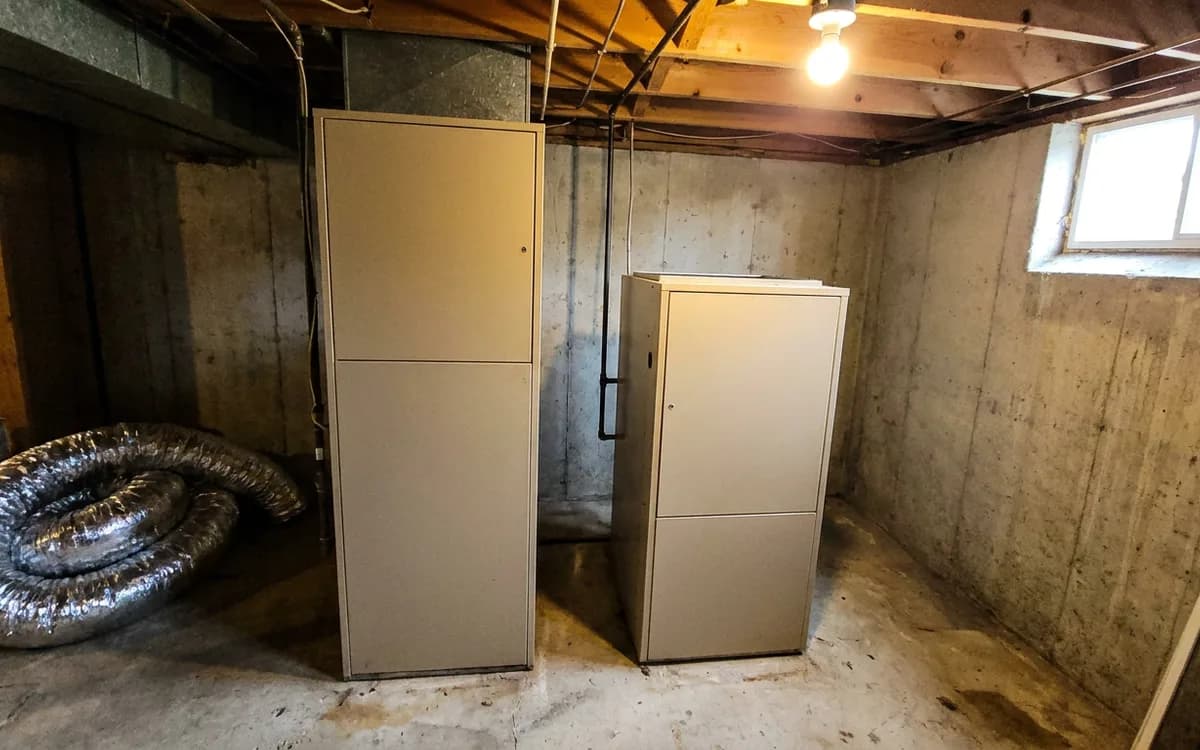
A single number at the bottom of a page isn't a quote. Ask for these four, because each one is either negotiable or explainable:
- Equipment — 40 to 60% of the total. An 80% AFUE single-stage runs $2,400 to $3,900. A 95%+ two-stage runs $3,550 to $6,100.
- Labor — 25 to 35%. Removing the old unit, setting the new one, gas connections, electrical, thermostat. Typically $3,000 to $6,900 depending on how tight and awkward the space is.
- Materials — 5 to 15%. Venting, gas piping, sheet metal transitions, mounting hardware.
- Permit — $80 to $150 in the Denver metro, pulled by the contractor.
What is not in the quote
These get discovered mid-job and they are the difference between a $7,400 project and an $11,000 one:
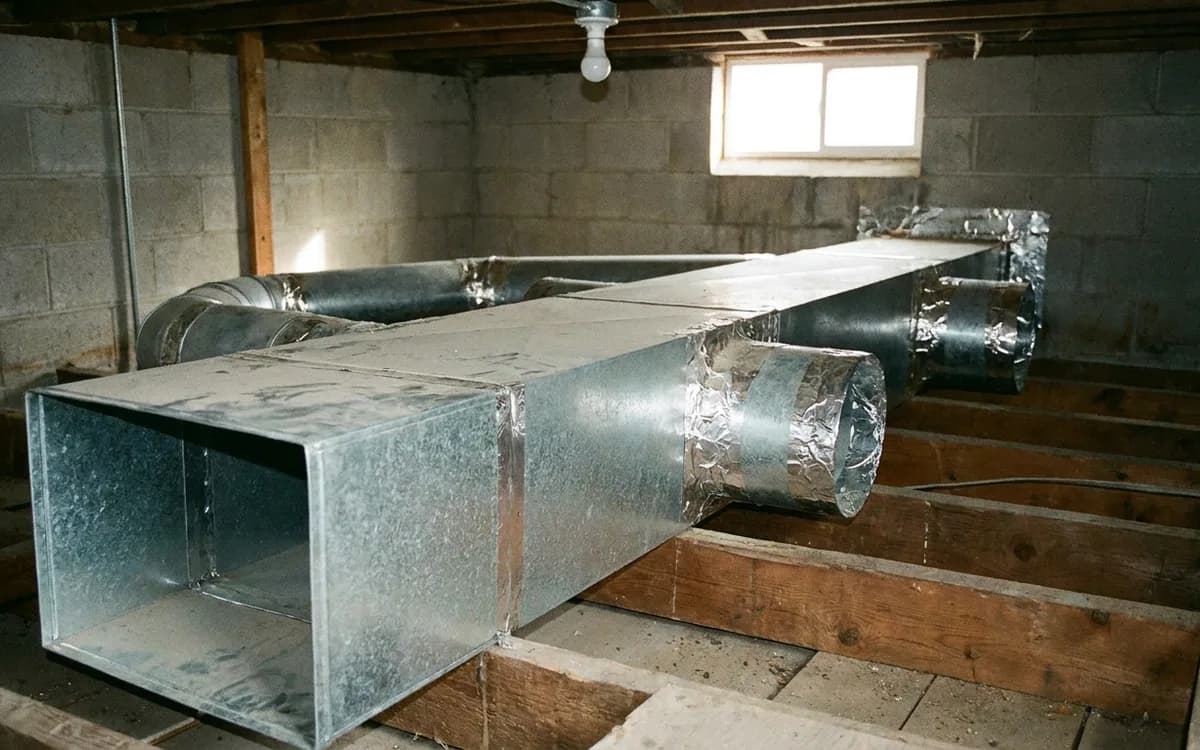
- Ductwork modification: $1,600 to $5,550 and up. Older Denver homes were frequently ducted for a furnace with different airflow requirements than a modern one. If the returns are undersized, a properly sized new furnace can't move the air it's rated for.
- Electrical panel upgrade: $3,750 to $7,100. Only relevant if you're going electric, but it's a large number to meet by surprise.
- Thermostat: $150 to $500. Minor, but it should be stated rather than assumed.
Ask directly whether your ductwork was evaluated and whether anything in the house needs work beyond the furnace itself. A contractor who has actually looked will answer specifically.
Rebates and tax credits that actually exist
Install a natural gas furnace at 95% AFUE and Xcel Energy pays a $225 rebate. A 95% boiler is $225, and a 95% boiler with an indirect water heater is $325. Those figures are published on Xcel's own heating equipment rebate page.
This is worth stating clearly because at least two Denver contractor pages currently ranking for furnace searches tell homeowners that furnace rebates ended in 2026 and only heat pumps qualify. That's incorrect. Xcel is cutting the heat pump bonus rebates — a separate program for different equipment — and the distinction got lost somewhere in the retelling.
On the federal side, a qualifying high-efficiency gas furnace can be eligible for a tax credit worth 30% of the project cost up to $600. Eligibility rules change; confirm the current year's terms before you count on it.
$225 won't decide an $8,000 purchase. But you should get it, and it's worth noticing when a company tells you money doesn't exist when it does.
How to read three quotes that do not match
Get three. They'll disagree, and the disagreement is informative once you know where to look.
Line the equipment up first — a 95% two-stage against an 80% single-stage isn't the same product, and the price gap is mostly that. Then check whether venting work is included in one and absent from another. Then confirm all three quoted the same capacity; if one specced a noticeably smaller furnace, either they did a real load calculation the others skipped, or they're undersizing to win on price.
Ask each of them: What capacity did you calculate and how? Is the permit included? Did you evaluate the ductwork? What's the labor warranty, and how long is the manufacturer's parts warranty?
The cheapest quote is occasionally the right one. It's rarely the right one when it's cheapest because something was left out.

When you should not buy a furnace at all
If your furnace is under 15 and the repair is a few hundred dollars, repair it. The $5,000 rule is the quick screen: repair cost times furnace age, and over $5,000 leans replacement. A $400 fix on a 20-year-old unit is $8,000 — replace. The same fix on a 6-year-old unit is $2,400 — repair.
Two things override the arithmetic. A cracked heat exchanger is a replacement conversation at nearly any age, because it's a combustion-gas issue rather than a comfort one. And a 22-year-old furnace that still heats evenly and hasn't needed a repair doesn't have to be replaced on schedule for being old.
If you're weighing it, furnace repair or replace in Denver works through the decision. If you're comparing equipment, high-efficiency furnaces in Denver covers what the AFUE jump actually buys, and heat pump vs furnace in Denver covers the bigger fork.
Get a real number for your house
Every range on this page is a planning range. Your number depends on your square footage, your ductwork, your gas line, your venting, and how hard the furnace is to get to.
Call (303) 226-1486 or send the form and one insured local heating professional will come measure and put it in writing. No call list, no obligation.
What Size Furnace Are You Replacing?
Furnace price tracks two things above everything else: how much heat your house needs, and how efficient the unit is. Pick both and you get the planning range from the table above — not a quote.
Planning range: $6,850 to $10,100
A standard-efficiency furnace reuses your existing chimney venting, so there's no flue conversion cost. It will not qualify for Xcel's $225 high-efficiency rebate, and any unit installed in Colorado now has to meet the state's low-NOx requirement — ask the contractor to show you the model's compliance, because that is on them, not you.
Add a Denver-area mechanical permit at $80 to $150, which your contractor pulls. If the ductwork needs rework, that's a separate $1,600 to $5,550 and you should see it as its own line.
This is a planning range, not a quote. Real numbers come from someone who has looked at your ductwork, your gas line, and your chimney.
Get Free EstimateQuestions
Frequently Asked Questions
What is the average cost of a furnace installation in Denver?
Plan on $6,300 to $8,650 for a standard-efficiency gas furnace with equipment and labor, with about $7,400 as the middle. Angi's Denver figures come in lower — $4,924 average, $2,914 to $6,933 normal range — because that data blends in smaller units, simpler swaps, and some equipment-only pricing. Neither number is wrong. They're counting different things.
Why are furnace quotes in Denver so different from each other?
Usually equipment tier and what's included. A quote using an 80% AFUE single-stage furnace has $2,400 to $3,900 of equipment in it; a 95% two-stage has $3,550 to $6,100. Add PVC venting if you're converting to condensing, and the gap widens by another $899 to $1,965. Get all three quotes broken into equipment, labor, materials, and permit and the differences usually explain themselves.
Does a high-efficiency furnace pay for itself in Denver?
It depends on how long you're staying. A 95% AFUE unit burns roughly 15% less gas than an 80% unit, and it qualifies for Xcel's $225 rebate. But if you're converting from standard efficiency you're also paying $899 to $1,965 for new PVC venting. Over a 15-to-20-year life in a cold climate the math usually works. Over five years before you sell, it often doesn't.
How much is a furnace permit in Denver?
A mechanical permit in the Denver metro typically runs $80 to $150, and the contractor pulls it as part of the job. It should be a line on your quote. If a contractor offers to skip the permit to save you money, that's a reason to call someone else — the inspection is the only independent check that the gas and venting work was done correctly.
Is it cheaper to repair my furnace than replace it?
Sometimes, and an honest contractor will say so. The quick test is the $5,000 rule: multiply the repair quote by the furnace's age, and if the result clears $5,000, replacement is usually better money. A $500 repair on a 19-year-old furnace is $9,500 — replace. The same repair on a 7-year-old unit is $3,500 — fix it.
What size furnace do I need and how much does size change the price?
Roughly 30 to 60 BTUs per square foot is the starting point, so a 2,000 sq ft home lands near 60,000 to 120,000 BTU. Going from a 40,000 BTU unit to a 120,000 BTU unit moves the installed range from about $5,650–$8,600 up to $7,700–$12,300. A proper load calculation matters more than the rule of thumb, especially at Denver's altitude where gas furnaces lose about 4% of capacity per 1,000 feet.
Can I finance a furnace replacement?
Most Denver HVAC companies offer financing, and Xcel Energy has its own energy-efficiency financing program for qualifying equipment. Read the terms the same way you'd read a car loan — a low monthly payment across a long term can cost more than the furnace. Ask for the total amount financed and the total you'll have paid at the end.
Do electric furnaces cost less to install in Denver?
The unit itself can, but the installed picture often isn't cheaper: $6,100 to $11,200, plus $562 to $1,965 for a 220V circuit if you're converting from gas, plus $3,750 to $7,100 if the electrical panel needs upgrading. Colorado's winters also mean an electric furnace usually costs more to run month to month than natural gas.
Ready to get started?
Get connected with one local, insured heating professional. Honest sizing, a real number, and no obligation to buy.